

Since the dismantling of USAID and the cuts to aid budgets among most major donors, foundations have come under enormous pressure to fill the void left by public funders. It is an expectation private philanthropy cannot meet, and the sooner everyone accepts that, the sooner it can turn to a more useful question: how to achieve impact at scale without the public partners philanthropy once relied on?
According to the OECD, foundations gave USD 68.2 billion for international development between 2020 and 2023, roughly a tenth of official development assistance (ODA) over the same period. In 2025 alone, ODA fell by 23 percent in real terms. Even a dramatic increase in philanthropic giving could not replace what donor governments withdrew in a single year.
Foundation leaders understand this. Many also believe, with good reason, that it is not philanthropy's job to occupy space that elected officials chose to vacate. Thus, for the past two years, most foundations have practiced triage: concentrating resources on the grantees in their existing portfolios that the cuts hit hardest, while fielding far more requests than they could ever fund. That was the right response to an emergency, but we are now at a point where a new approach is needed.
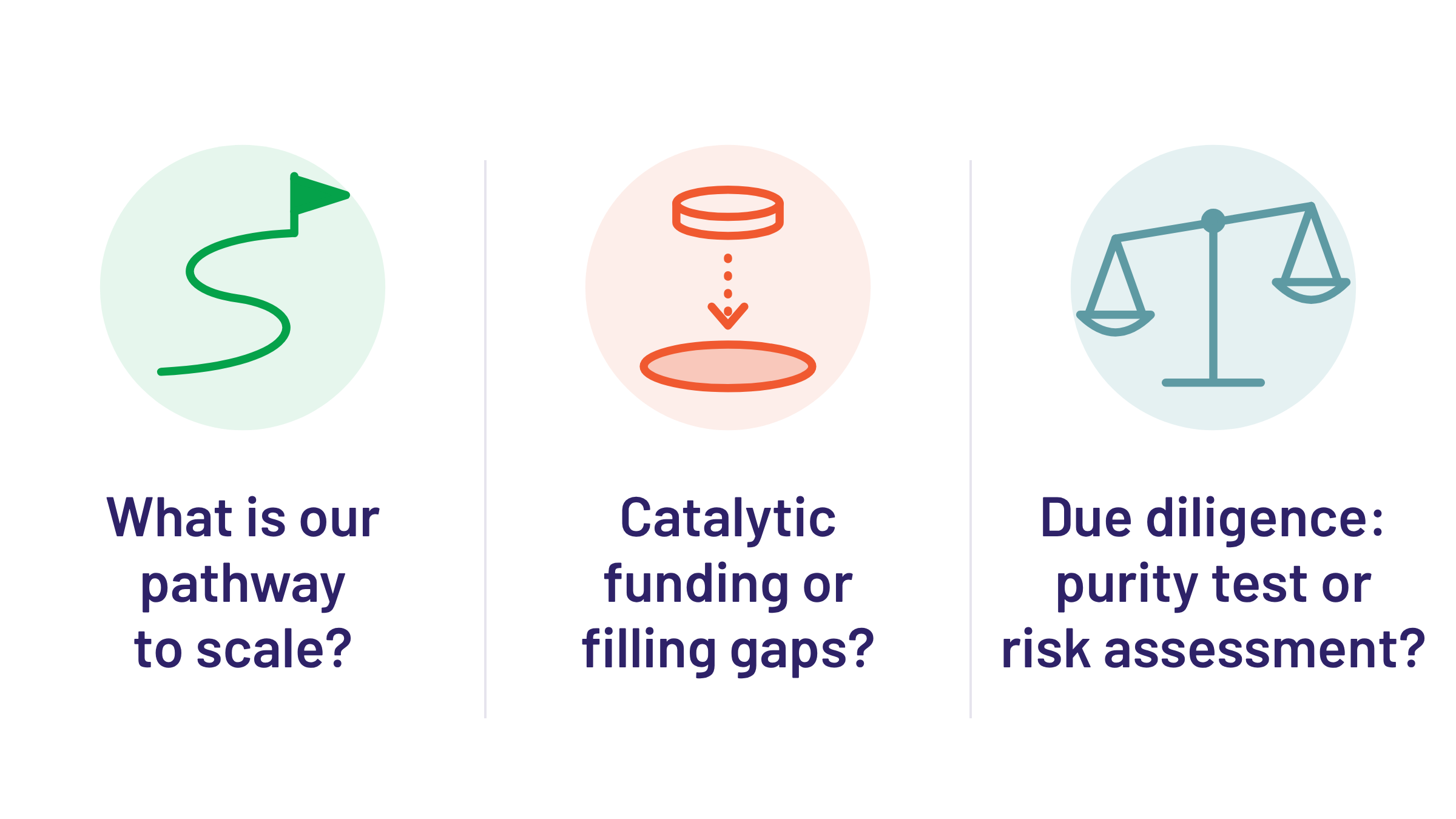
In Building Thriving Partnerships in an Age of Uncertainty, we argued that most partnership strategy of the past twenty years rested on an assumption of abundance: predictable public funding, growing corporate budgets, stable policy. For foundations, the end of that abundance has a specific consequence. ODA did more than fund programs. Bilateral donors and multilateral agencies often supplied the machinery of scale, from technical assistance inside ministries to the co-financing that carried a successful pilot into a national system. A foundation could fund the innovation and reasonably expect an ODA partner to take it further. With that partner diminished or gone, every foundation partnership now has to answer three questions before it begins.
Q1. What is our pathway to scale?
Few foundations can finance a proven intervention at national or regional scale on their own. The decisive question is who will pay for the solution once it works, and it belongs at the design stage, not at the end of a pilot. A recent piece in the Stanford Social Innovation Review, argues that the answer depends on the nature of the problem: whether the solution is a public good, whether it depends on networks, platforms, or competition, and where state capacity actually exists. In our experience, that analysis usually points down one of two pathways, a public pathway and a private one.
The public pathway applies to solutions that create pure public goods, particularly in education, governance, and public health. Childhood immunization and early grade reading are two clear examples; with few exceptions, governments pay for them. Here, government budgets dwarf anything philanthropy can offer. Writing in SSIR, Rakesh Rajani and Tim Hanstad note that annual government spending in India is more than 50 times the country's annual private giving. In this context, a foundation on the public pathway is not funding delivery. Instead, it is funding adoption: the costing work, evidence, and technical support that persuade a ministry of finance to put the intervention in its budget and keep it there. That work is slow and political, and the aid cuts have made it harder by squeezing the fiscal space of the very governments foundations need to persuade. Choosing a partner government with both the will and the budget headroom to absorb the program is now as important as choosing the program.
The private pathway applies to solutions that can generate revenue: mobile money, pay-as-you-go solar, crop insurance, improved agricultural inputs. Walji correctly points out that many of the most consequential anti-poverty technologies of the past two decades scaled through companies rather than governments. Kenya’s M-Pesa is perhaps the best-known example of a vital anti-poverty technology that scaled through the private sector. Here, the scaling partner is a company, an investor, or a development finance institution, and the foundation's job is to absorb the early risk that commercial capital will not, and to fund the market-building that no single firm will pay for alone, such as farmer training, product standards, or distribution infrastructure.
Many solutions, particularly in agriculture and health, sit between the two pathways and need both a public payer and a private delivery channel. That is fine, as long as the foundation knows which partner carries which part of the cost before it commits.
Q2. Are we providing catalytic funding or filling gaps?
There is nothing wrong with gap-filling. In the current environment, it is often exactly what grantees need. Problems arise when foundations, or their grantees, mistake gap-filling for catalytic funding.
Gap-filling funding sustains an essential service that lost its public funding. Its measure of success is continuity, and its natural endpoint is the moment another funder, usually a government, resumes responsibility. Catalytic funding is different in kind. Its measure of success is what other actors do because of it: a ministry that adds a line item, a development finance institution that makes a loan it would not otherwise have made, a company that changes its procurement. Catalytic money works through instruments built for that purpose, such as first-loss capital, guarantees, results-based payments, and technical assistance tied to a specific investment or funding decision.
Q3. Due diligence: purity test or risk assessment?
Partnering inevitably requires coming to grips with a partner’s mixed track record – whether that is a corporation with troubling environmental practices or a government with a history of human rights abuses. Many foundations approach these partners with due diligence designed as a purity test. The underlying question is whether the partner is good enough to be associated with the foundation's name. Few organizations with the resources to scale anything will pass that type of test.
A purity test protects reputation, but it also constrains strategy, filtering out the very partners who control the budgets, supply chains, and distribution networks that scale requires.
Risk assessment asks a different question: what could go wrong in this specific partnership, how likely is it, and how will we manage it? A risk-based approach treats a partner's history as information rather than a verdict. It leads to concrete design choices, including clear roles and decision rights, transparency commitments, independent monitoring of results, and exit terms agreed at the outset. It also lets a foundation accept residual risk deliberately, rather than avoiding it by default.
World Wildlife Fund-US offers an effective model of a risk assessment approach. Before WWF enters a corporate partnership, Resonance prepares a detailed due diligence report on the prospective partner’s financial, social, environmental, and human rights practices. Each dimension is scored, and specific risks are flagged for WWF’s consideration. The report is not treated as a pass-fail verdict. WWF shares it with the prospective partner, and the two organizations work through the findings together to agree on how the risks will be managed. In some cases, that process leads WWF to decline the partnership. More often, it produces something far more constructive and impactful: a partnership with risk mitigation built in from the start, and a partner with a shared agenda for improving its own practices.
Philanthropy as the broker of other people's capital
For most of the past two decades, ODA donors answered the scale question for philanthropy, often implicitly. This is no longer the case and it has a profound implication for foundation strategy. In an age of abundance, influence and impact often correlated to the size of the grant-making budget. In an age of uncertainty, influence and impact will increasingly be shaped by a foundation's ability to bring governments, companies, and investors into commitments they would not have made on their own. That is a different skill set, built on partnership design, financial structuring, and the judgment to work with imperfect partners. By investing in those capabilities, a foundation can amplify its impact and better navigate this age of uncertainty.
All of this leaves foundation leaders with an uncomfortable question: how many of the partnerships in their portfolios were designed for an era that has already ended? Answering it honestly may mean restructuring some commitments and walking away from others. That kind of self-examination is not easy, but the payoff, in greater impact and relevance in the Age of Uncertainty, is significant. Our Partnership Development Guide offers a framework for that work, and we would welcome comparing notes with those prepared to take it on.
Steve Schmida is the founder and CEO of Resonance and author of Partner with Purpose: Solving 21st Century Business Problems through Cross-Sector Collaboration.
