


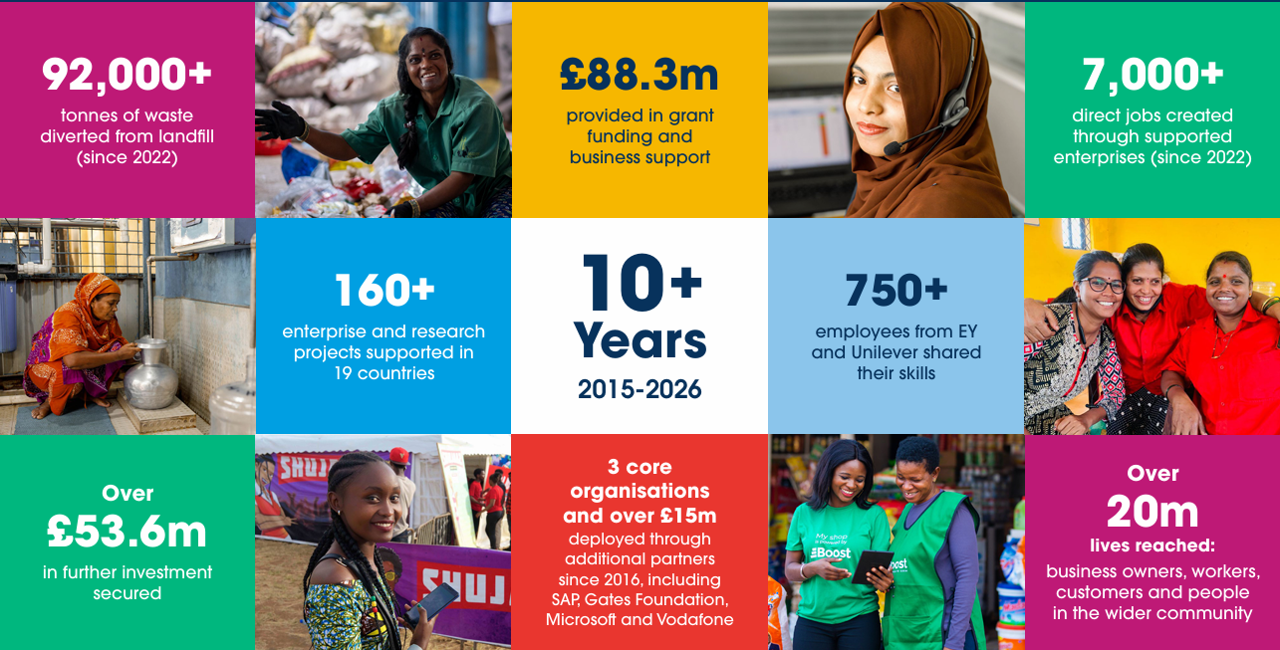
By nearly any standard TRANSFORM has been an incredibly successful program:
It diverted >92,000 tons of waste from landfills since 2022.
It created >7,000 jobs directly through the supported enterprises (also since 2022!).
It received a rating of A+ in its most recent annual review by FCDO, highlighting Resonance's governance support.
The enterprises it supports secured £53.6 million in additional investment beyond TRANSFORM funding.
So as TRANSFORM celebrates more than 10 years of impact and prepares to wind down at the end of the year, it is important to take a moment and assess how the initiative was able to achieve so much.
What is TRANSFORM and why is it impressive?
TRANSFORM is a multistakeholder platform and impact accelerator to test and scale market-based solutions that build sustainable economies, empower marginalized communities, and drive climate-resilient growth. It was created as a cross-sector initiative between Unilever, the UK Government's Foreign, Commonwealth & Development Office (FCDO) and EY.
Over the last decade, it has supported 160+ enterprises across 19 countries and reached over 20 million people across Africa and Asia. It also compellingly makes the case that public-private partnerships work when they’re built well. What makes it all possible is the machinery underneath.
The Work Behind the Work
Resonance joined the partnership for its final two years to hold the operational architecture together during a complex and demanding final phase. TRANSFORM channeled over £88 million in grant funding and business support to impact enterprises across two continents. It also managed cohorts of grantees at different stages, in different countries, and under different regulatory and financial environments.
Whereas a standard project answers to a single organization, with one set of priorities, one approval chain, and one definition of success, TRANSFORM brought together three very different organizations around a shared mission — a multinational FMCG company, a UK government department, and a global professional services firm. Each partner had its own mandates, decision-making rhythms, and appetite for risk. Partner coordination and stakeholder management was a key aspect of ensuring TRANSFORM closed out successfully for all partners.
For TRANSFORM’s final two years, the partners brought Resonance in to hold the operational architecture together. They felt the partnership needed an independent project manager with deep partnership, governance, and grants expertise—someone to sharpen operations and carry the program through the final phase of work.
Having already helped structure, build, and manage a separate $25 million alliance with Unilever and EY, Resonance came to TRANSFORM with a proven model for success. We could contribute in a team with expertise in partnership facilitation, grants management, financial oversight, and analytics to strengthen TRANSFORM efficiency, streamline communications, and ensure positive governance.
What Made the Difference
Four lessons stand out from our work with the TRANSFORM partnership:
1. Ensure funding is reliable and adaptive to evolving business needs
Disbursing grant funding to early-stage enterprises in emerging markets requires rigorous selection and onboarding processes, ongoing oversight of progress and compliance with multiple requirements, and a reliable disbursement process. Late or unpredictable payments undermine trust and can derail the very business models you’re trying to support. For grantees operating in contexts with limited financial buffers, knowing an expected payment will arrive on time is foundational.
Resonance managed the TRANSFORM India selection and onboarding end-to-end, engaging a multistakeholder regional panel from across FCDO, Unilever and EY. The panel reviewed 151 applications, narrowed the pool down to ten finalists, and selected four grantees for award. From there, Resonance ran the full grants pipeline: due diligence, contracting, milestone-based disbursement, financial reporting and compliance. We provided grantee oversight that gave partners and donors confidence in both project progress and how funds were moving.
For one grantee, Terra Ecopreneurs LLP, extended rainfall delayed harvesting, input application, buyer interactions, and training. This forced Terra to reschedule deferred activities, diversify its product offering, and strengthen vendor linkages. Rather than require a formal grant modification, we allowed earlier milestone disbursements so Terra could maintain momentum without compromising accountability. Terra is now working with eight Farmer Producer Organizations representing roughly 3,140 tribal and marginal farmers, surpassing its 3,000-farmer target halfway through the grant.
2. Make Coordination Across Organizations Feel Effortless
Multi-stakeholder partnerships generate a particular kind of governance challenge: getting multiple decision-makers aligned on the right calls, at the right time. At its best, governance feels effortless, with decisions made in a timely fashion, based on adequate information, with time for consideration and discussion, according to an established process. When everything functions smoothly, governance happens almost in the background. When it’s not working, it can derail all other work.
We ran TRANSFORM’s Management Team meetings and the wider governance cycle as a neutral broker between the core partners. Agendas and pre-reads were designed to facilitate decision making. We intentionally surfaced tensions early and addressed them directly, making sure every partner left the table with the same understanding of agreements and next steps. A successful secretariat is like a swan, paddling furiously under the water while keeping the surface as smooth as glass.
3. Turn Grantees into Partners
The most fruitful grantee relationships see recipient enterprises as stakeholders rather than beneficiaries. TRANSFORM was designed and built so that grantees would act as the conduit to local impact. Regional stakeholder convenings deliver real-time intelligence across markets and give local actors a seat at the table.
One entrepreneur pitched the TRANSFORM panel with a proposal to vertically integrate their business through automated refill stores to make buying more convenient for customers. Later, the same entrepreneur gave a live walkthrough of the operational storefront, shared what they had learned, and offered plans to keep scaling. Such feedback sessions highlight new areas of support needed based on local realities and can turn a grantee-funder relationship into genuine partnership.
4. Capture What Worked and Where to Lean In
Long-term programs (TRANSFORM has run for over a decade!) produce an enormous amount of data. Resonance drew learning reports drawn from grantee deliverables and shared them with the partners regularly, surfacing highlights and patterns across the network.
One such pattern was the treat of digital infrastructure among grantees with the strongest impact. These entrepreneurs treated digital infrastructure as a scaling lever rather than back-office overhead. Lohjinawi, for example, built its own inventory platform, "Lohjin," to track stock moving in and out of warehouses in real time, giving off-takers visibility into available capacity and laying the foundation for scale.
Why This Matters
TRANSFORM has plenty to be proud of, including reaching 20 million lives, unlocking £53 million, and creating 7,000+ jobs. That success is built on thousands of operational decisions made consistently, over years. The TRANSFORM guidebook includes a principle that resonates with us (pun intended): “start small, build in flexibility, and get the structures right.”
The guidebook, drafted by Unilever, FCDO, and EY, covers additional learnings around partnership design, enterprise selection, local leadership, and value chain integration. We encourage organizations interested in learning more about TRANSFORM to reach the full guidebook.
For Organizations Building Partnerships
If you’re designing a public-private partnership, whether for international development, climate, health, or economic inclusion, the strategic vision is only the start.
The harder question is: how will this be operationalized and deliver results on the ground?
Resonance specializes in program management, financial oversight, and governance infrastructure that turns ambitious partnerships into functioning, accountable, high-performing programs.
If you’re working on something like this, we’d welcome a conversation!
