

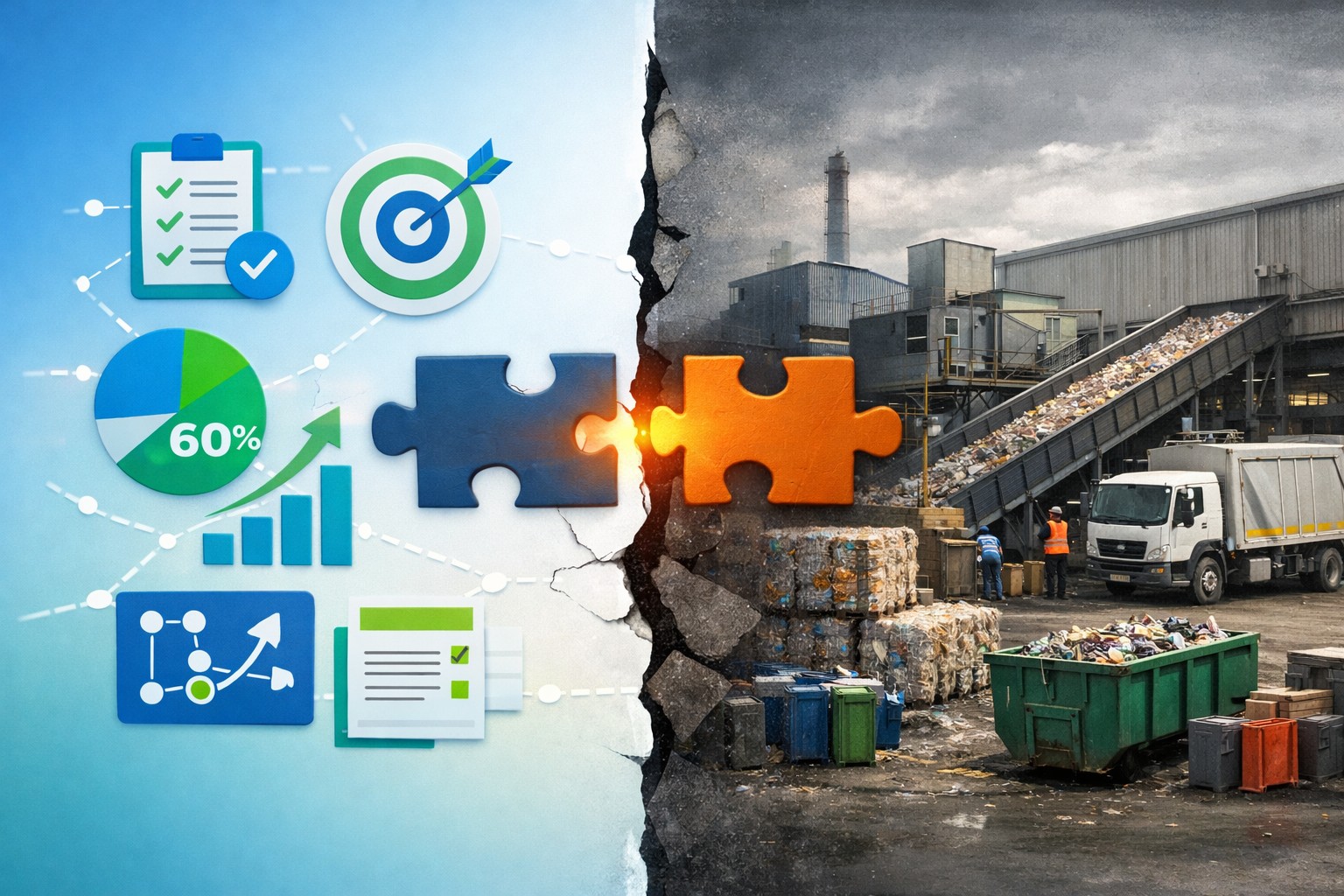
Here is what the data shows: ambition in the circular economy is outpacing execution by a dangerous margin.
In the past eighteen months, we've watched a striking acceleration. Of the 22 new circular economy frameworks launched in 2025, 16 came from developing countries.1 This is a complete reversal from even two years ago when Europe dominated the policy landscape. The EU is preparing its New Circular Economy Act, positioning circularity as a pillar of economic competitiveness, not environmental compliance. 2 Even the language has shifted. Policymakers no longer talk about circularity as an environmental agenda. They talk about it as industrial and economic strategy.
This is recognition of something structural. Linear models (extract, produce, consume, dispose) are colliding with geopolitical drivers, climate realities, and tightening resource constraints. Yet while circular economy discussions have tripled in the past five years, the global circularity rate has actually fallen from 9.1% in 2018 to just 6.9% by 2025. 4 Over the same period, humanity consumed 500 billion ton of virgin materials—nearly as much as was consumed during the entire 20th century. Food-grade recycled PET now costs significantly more than virgin material in European markets, forcing beverage companies to import recyclates they should be sourcing domestically. The International Energy Agency projects that recycled critical minerals could incur around 80% less greenhouse gas emissions than primary mining—but only if the recovery infrastructure exists.3
The circular economy has won the argument. We all agree it is needed. What it hasn't won yet is implementation.
The Gap Between Policy and Practice
A comprehensive analysis published in December 2025 by UNIDO and Chatham House examined 99 national circular economy roadmaps and strategies encompassing more than 4,300 individual policy commitments. Only 36% of those commitments are specific enough to be implemented. Most lack basic elements like assigned ownership or clear timelines. Another 43% have neither.
Think about what that means in practice. A government announces a target: 30% recycled content in packaging by 2030. The target appears in a strategy document. It gets cited in speeches and press releases. But no one is responsible for building the sorting facilities. No funding mechanism exists to upgrade collection systems. Producer responsibility schemes remain poorly governed or non-existent. The target becomes aspirational at best, misleading at worst.
This isn't a global south or a global north problem. It's a systems problem that cuts across geographies and income levels. The same gap appears whether you're looking at battery recycling infrastructure in Europe, plastic waste management in Southeast Asia, or textile circularity in North America.
And the consequences are starting to show. Companies are importing recycled materials they should be sourcing domestically. Local collection rates haven't improved enough to keep up with demand. Recycled content mandates drive up costs without driving up actual circularity. In the EU alone, more than 900 bottling sites—most of them SMEs anchored to rural territories—face investment decisions tied to 15-year infrastructure cycles but lack the regulatory certainty to commit capital. Investment in recycling infrastructure stalls because regulatory frameworks remain too uncertain or too complex—particularly for the small and medium enterprises that make up the backbone of many supply chains.
Circularity Requires Coordination, Not Just Commitment
The implementation gap exists for a reason that should be obvious but often gets overlooked: circular economy transitions are coordination problems, not information problems.
Everyone involved generally understands what circularity requires in principle. The challenge isn't knowledge. We don't need more "playbooks" and "toolkits." The challenge is aligning incentives, synchronizing investments, and building the connective tissue between actors who operate on different timelines, cater to different stakeholders, and measure success with different yardsticks (meter sticks?).
Extended Producer Responsibility (EPR) is one of the most widely adopted circular economy mechanisms. It sounds straightforward: producers finance the collection and recycling of their packaging. But effective EPR requires coordinating municipal waste systems, logistics networks, recycling facilities, quality standards for secondary materials, and transparent governance structures to prevent fee diversion or market manipulation.
The UNIDO analysis identified 101 EPR-related actions across 30 countries, but only 30% achieved high specificity in implementation. Poorly designed EPR systems are already creating problems—in some EU member states, producer fees are being diverted to unrelated public spending rather than reinvested in collection and recycling infrastructure, undermining both competitiveness and material access.
Take the clean energy supply chain challenge that Korea Zinc's leadership outlined ahead of this year's World Economic Forum in Davos3. Recycling lithium-ion batteries at scale requires not just technology but coordination across automotive manufacturers, energy companies, recycling facilities, mining companies (who may see recyclers as competitors), trade policy, and carbon accounting frameworks. The technical capacity exists. What's missing is the architecture that allows those capabilities to function as an integrated system rather than isolated pilots.
This is where the current wave of circular economy policy risks falling short. Most frameworks were developed through limited stakeholder consultations. They reflect what was politically achievable or technically understood at a particular moment, not necessarily what the system requires to function. The result is a collection of well-intentioned but uncoordinated actions that don't add up to transformation.
What Implementation Actually Requires
The gap between circular economy ambition and circular economy reality won't close through more public commitments and commiseration. It will close through three specific shifts that require external expertise.
- Translating policy into investment opportunities. Fewer than 10% of national circular economy strategies include detailed financing plans, but private capital won't flow to vague commitments or unquantified opportunities. While $164 billion was invested globally in circular business models between 2018 and 2023, this represents just 2% of all tracked capital—and 95% of it flows to conventional applications like car repair and resale rather than transformative innovations in design and production.5 Bridging this gap means developing bankable projects, structuring blended finance mechanisms, and creating the analytical foundation that allows institutional investors to underwrite circular infrastructure. This is specialized work. It requires people who understand both policy intent and financial structuring, and who can translate between the two.
- Strong multi-stakeholder governance. Circular systems change requires getting actors with competing interests to collaborate over multi-year timeframes. This doesn't happen through one-off convenings, or even a monthly call. It requires designing governance structures with clear decision rights, accountability mechanisms, and dispute resolution processes. It requires sustained facilitation by people who can navigate corporate, government, and civil society cultures. And it requires independent secretariats or PMOs with the authority to hold parties accountable.
- Establishing the monitoring infrastructure to track progress and course-correct. Most circular economy commitments aren't systematically linked to specific actions or measurable indicators. Of the 247 individual quantitative targets identified across national frameworks, most remain non-statutory and disconnected from implementation pathways. Without that linkage, there's no feedback loop. Governments can't tell if policies are working. Companies can't demonstrate progress credibly. Investors can't assess performance. Building the infrastructure (defining indicators, establishing baselines, creating reporting systems, analyzing trends) is unglamorous work. It is also essential and needs to be integrated from the beginning.
None of this happens organically. It requires dedicated capacity that most individual organizations don't maintain in-house. It requires people whose job is to sit at the intersection of policy, markets, and implementation, and who can translate across those domains. With fewer than 10% of frameworks addressing international coordination, and governance mechanisms receiving only 2.5% of all policy actions globally, the coordination infrastructure simply doesn't exist in most contexts.
Why This Matters Now
We're at an inflection point. The circular economy has transitioned from niche concept to mainstream agenda. That's progress. But rapid proliferation of policies without corresponding implementation capacity creates a credibility problem. When ambitious targets consistently fail to materialize, the political and social capital required for genuine transformation erodes.
This risk is particularly acute in low-income countries. Fully 33% of all frameworks globally are now donor-funded, up from 25% just one year ago. If these strategies become another round of unfunded mandates or unimplemented plans, the backlash won't just undermine circularity. It will undermine trust in collaborative governance.
The opportunity side is equally important. Companies are facing real pressure to secure reliable supplies of recycled materials, reduce supply chain emissions, and meet tightening regulatory requirements. Only 9% of existing frameworks explicitly address trade dimensions or cross-border coordination—yet companies operate in precisely these multi-jurisdictional contexts. Governments recognize that circular economy transitions can drive industrial competitiveness, create quality jobs, and reduce import dependence. Philanthropic funders and bilateral donors are looking for interventions that deliver measurable impact at scale.
Seizing the circular economy opportunities requires moving past the planning phase. We need to convene the right actors, structure viable partnerships, mobilize finance, and build the accountability systems that turn commitments into outcomes.
Building the Infrastructure for Transformation
The circular economy is bigger than any single sector, geography, or policy framework. It's a fundamental restructuring of how materials flow through the global economy. That scale is exactly why implementation requires external coordination.
No individual company can redesign a value chain alone. No single government ministry can align all the actors required for systems change. No bilateral donor can fund circularity into existence without the on-the-ground partnerships that make investments productive.
What's needed is strategic support that can bridge these gaps—expertise in translating policy into action, convening multi-stakeholder partnerships that function, structuring finance that flows to real projects, and building the monitoring systems that create accountability.
The transition to a circular economy will happen. The question is whether it happens through fragmented, inefficient efforts that waste resources and erode trust, or through coordinated action that delivers genuine economic, environmental, and social value.
The implementation gap is where that question gets answered. Closing it isn't optional. And it isn't something most organizations can do alone.
Endnotes
[1] Barrie, J., Schröder, P., Pfaff, M., & Stucki, J. (2025). Global Stocktake of National Circular Economy Roadmaps and Strategies: 2025 Update. United Nations Industrial Development Organization (UNIDO) and Chatham House. https://www.unido.org/sites/default/files/unido-publications/2026-01/Stocktake%20CE%20Roadmaps%202025.pdf
[2] Natural Mineral Waters Europe. (2026, February 11). Europe's New Circular Economy Act: Getting the basics right for EU competitiveness. The Brussels Times. https://www.brusselstimes.com/1937610/europes-new-circular-economy-act-getting-the-basics-right-for-eu-competitiveness
[3] Choi, Y. B., & Kim, K. (2026, January 7). How a circular economy could strengthen the clean energy supply chain of the future. World Economic Forum. https://www.weforum.org/stories/2026/01/circular-economy-clean-energy-supply-chain-critical-minerals/
[4] Circle Economy. (2025). The Circularity Gap Report 2025. https://www.circularity-gap.world/2025
[5] Based on data from circular economy investment tracking platforms and market analysis, 2018-2023.
